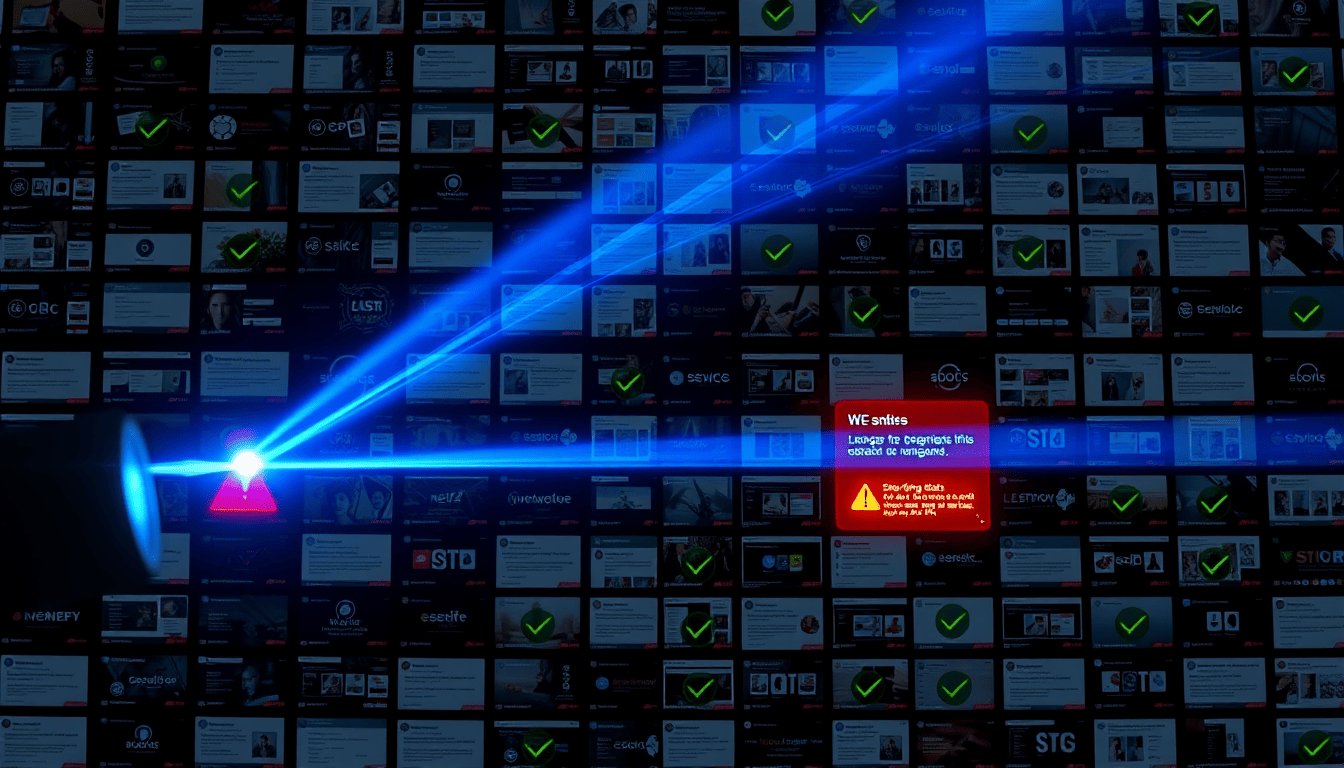

The best outbound lead isn't a business with money. It's a business with a visible, provable problem you can fix — because that's a conversation that writes itself. And nothing is more visible or more provable than a website that's insecure, painfully slow, or completely down. You don't have to convince them they have a problem. Their own browser is already showing their customers "Not Secure" in the address bar.
So we built a scanner that reads an entire prospect database and, in about the time it takes to sip your coffee per site, flags exactly which businesses have something wrong with their site. The output isn't a report. It's a call sheet — ranked by severity, warmest problems first.
"A business with a broken site is pre-qualified. The pain is real, it's visible to their customers right now, and you can prove it in one screenshot. That's not a cold lead — that's a warm one that doesn't know it yet."
What the scan actually checks
Each site gets run through a battery of fast, independent checks. None of them require a human; all of them run in parallel across the database. Here's what fires against every URL.
| Check | What it catches | How |
|---|---|---|
| TLS / SSL | Expired, missing, or misconfigured certificates — the "Not Secure" warning that scares off customers. | Direct TLS handshake |
| Uptime | Sites that are down, timing out, or throwing server errors right now. | HTTP status probe |
| Speed & mobile | Slow load times and broken mobile layouts — the silent conversion killers. | PageSpeed API |
| Malware / blocklist | Sites flagged as compromised or serving malware — an urgent, embarrassing problem. | URLhaus lookup |
| Tech stack | Fingerprints the platform (aging WordPress, abandoned builders) so the pitch is specific. | Wappalyzer fingerprint |
The scan runs directly against the site rather than trusting a third-party rating, and it's fast because each check is cheap and everything runs concurrently. A database of a few thousand prospects clears overnight. By morning, every site has a health record and every problem has a row.
The output: a severity-ranked call sheet
Raw scan results are useless as a wall of data. The value is in the ranking. Every issue found writes a record — the business, the specific problem, and a severity — and those roll up into a single prioritized call sheet. An expired SSL cert on a business that clearly depends on its website outranks a mild speed issue on a marginal one. The list sorts itself so the warmest, most-provable pain is at the top.
That call sheet is the entire point. Instead of cold-dialing a scraped list, you're calling businesses where you can open with a specific, true, urgent statement:
That message lands because it's true and timely. You're not pitching a redesign nobody asked for. You're telling a business that's obviously doing well that their front door is broken — and that's a message people are glad to receive.
The hard lesson: false positives will burn you
Here's the part that separates a scanner you can trust from one that embarrasses you. The first version of our SSL check was too naive, and it flagged sites as insecure that were actually fine — a valid certificate that the check misread, a redirect it didn't follow, a perfectly healthy site marked broken.
That is a disaster in outbound. If you call a business and confidently tell them their site is insecure when it isn't, you've done the opposite of building trust — you've proven you don't know what you're talking about, in the first sentence. We had to harden the SSL logic specifically to kill those false positives, because a scanner that cries wolf is worse than no scanner at all.
"The whole pitch rests on being right. One confident, wrong 'your site is insecure' call and you've torched your credibility before you said your name. False positives aren't a bug — in this use case they're an existential risk."
So the discipline is: never surface an issue you haven't verified enough to say out loud to a stranger. Better to under-report and be trusted than over-report and be dismissed.
Why this beats buying a “leads” list
A scraped list tells you a business exists. A scanned database tells you a business has a problem you can fix, today, and hands you the exact words to open with. Those are not the same asset. One is a phone book. The other is a queue of warm, pre-qualified conversations where you're the person bringing helpful, urgent news.
And it compounds with everything else. The businesses that don't have a problem today get re-scanned later — certs expire, sites go down, platforms rot. A site that's healthy this month lands on the call sheet the week its certificate lapses. The scan isn't a one-time report; it's a standing monitor over your whole prospect universe, quietly waiting to tell you the moment someone's front door breaks.
That's how a 30-second-per-site scan turns a static database into a self-refreshing source of qualified leads.