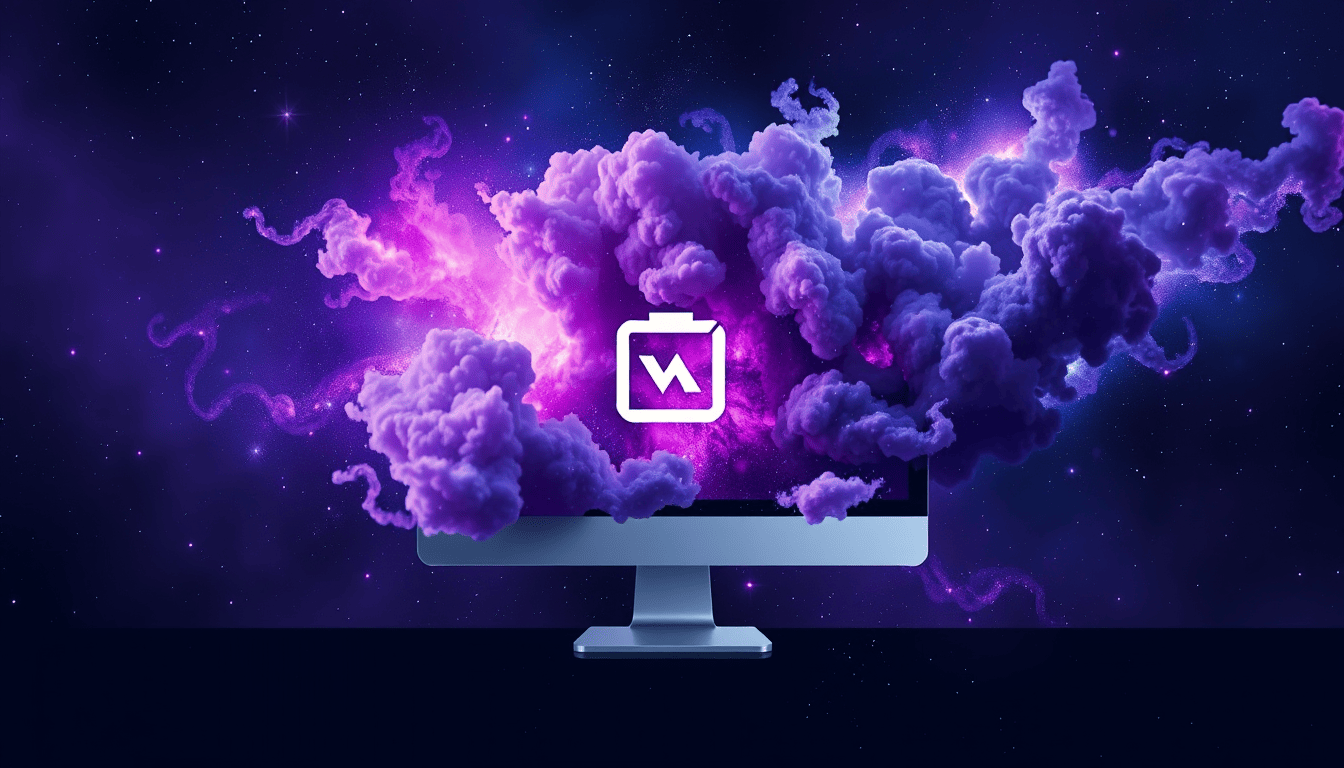

This actually happened. I typed something close to "can you revise this logo — it's dark-themed with circuitry elements, I want to try a version with more negative space." ChatGPT returned a file called dark-space-circuitry.png.
It's a dramatically lit galaxy scene. Deep navy sky fading to black. Glowing nebulae in violet and amber. Circuit-board patterns overlaid on the cosmos like a HUD in a sci-fi film. It's the kind of image that stops you mid-scroll. It's genuinely beautiful. It also has absolutely nothing to do with my logo, my brand, or anything I asked for.
I stared at it for a moment. Then I saved it to my Downloads folder, because of course I did — it's gorgeous — and went back to thinking about why this happened. Because understanding why it happened is worth more than the logo revision I didn't get.
What Just Happened
The short answer is that image generation models don't revise. They generate. That distinction sounds obvious when you say it out loud, but it collapses completely in practice when you're sitting in the ChatGPT interface with a text box in front of you and the feeling that you're "talking to" something.
The model has no concept of your existing asset. It can't see your logo. Even if you paste a description, it's working from language, not from the actual vector file sitting on your drive. It has no knowledge of your brand constraints — what colors you're locked into, what the mark looks like at small sizes, what your client approved six months ago. When you say "logo revision," the model reads a prompt and produces something that looks impressive and logo-adjacent. That's its entire job.
The training dynamics make this worse. Image generation models are optimized for outputs that get shared, upvoted, and praised. Cinematic. Dramatic. High production value. A technically correct logo tweak doesn't trend on Midjourney. A glowing galaxy does. The model isn't malicious — it's just shaped by what gets rewarded, and "wow" shots get rewarded.
The word "dark" in my description triggered space. The word "circuitry" triggered HUD overlays. The model literally hallucinated my brief into a movie poster.
That's not a bug, exactly. It's a feature working as designed in the wrong context. Image generation models are pattern-completion engines at scale. Feed them evocative words — dark, circuitry, tech, space — and they complete the pattern with the most visually compelling version of those words their training data contains. The output is coherent, beautiful, and completely divorced from your actual need.
Generation vs. Refinement
This is the core distinction that most people using AI image tools haven't internalized yet, and it's costing them time and money every week.
AI image tools are dream machines. That's not a criticism — it's a description of what they are extraordinarily good at. Hand them a concept, a mood, a visual direction, and they'll produce something from nothing faster than any human process could. That's remarkable. That's genuinely useful. That is the capability.
What they cannot do is work within constraint. A logo revision requires a specific set of operations that have nothing to do with dream generation:
- Respecting the existing mark — its proportions, its geometry, its construction logic
- Making targeted adjustments to specific elements without touching others
- Testing a color variant that maintains brand equity
- Making the thing work at 16×16 pixels on a browser tab
- Outputting a vector file that a printer can actually use
None of that is in an image generation model's vocabulary. It doesn't know what your logo is. It doesn't know what "revision" means in an operational, deliverable sense. It knows how to make something that looks good when you show it to someone who doesn't know the brief.
Stop thinking of DALL-E or ChatGPT image as Photoshop. It's a concept artist who has never seen your brand and works entirely from description.
That mental model fix is worth writing on a sticky note. A concept artist is brilliant at ideation and terrible at production. You wouldn't hand a concept artist your final deliverable and say "make a small change to the kerning." The same constraint applies here, only with less intuitive boundaries because the AI interface feels conversational rather than creative-tool-shaped.
The Right Tool for Each Job
Let's be concrete about where AI image generation earns its place and where it doesn't belong.
Where it’s genuinely excellent
- Hero section backgrounds
- Editorial / illustrative imagery
- Concept mockups for client decks
- Texture and pattern generation
- Mood boards and visual direction
- Blog hero images (like this one)
- Social graphic backgrounds
- Logo work — any of it
- Brand asset modification
- Anything requiring your existing files
- Production-ready graphics
- Design system consistency
- Print-ready deliverables
- Anything measured in pixels or points
For actual logo work — which means anything that starts with something you already have — the right tools are the ones that have always been right for logo work. Figma or Illustrator with a designer who can open your source file, make the change you're asking for, and hand you back a file you can actually use. That process takes 8 minutes when the designer has the file. It takes 45 minutes of prompt engineering when you're fighting an image generator, and the output still won't be right.
If you want to stay in the AI ecosystem, Adobe Firefly's image editing workflows are closer to what most people mean when they say "revision" — you can feed it a source image and constrain the changes. It's still not logo work, but it's operating in the right direction. The key is having the source file involved in the process at all.
What This Means for Agency Work
Agencies are making this mistake systematically. Not because they're unsophisticated — because the marketing around AI image tools has been so focused on what they can do that nobody's built an equally clear picture of what they can't.
The error usually looks like this: someone on the team discovers that AI can generate images. That's genuinely exciting — they're right. They start using it for everything visual. Then they get to a task that requires working with existing brand assets. They try to fit the image generator into that task because it worked last time. They spend 45 minutes not getting what they need. They either give up and call a designer (the right move, delayed by 45 minutes) or they ship something that doesn't actually match the brand (the wrong move, with downstream consequences).
If the task requires your existing brand assets, AI image generation is the wrong starting point. Full stop. Use it for net-new creative. Hire a human for anything that starts with something you already have.
This is a rule worth putting in your agency's AI operating procedures explicitly, not just leaving it as tribal knowledge. The line is: net-new creative versus modification of existing assets. One of those is an AI image generation task. The other one isn't, and it never will be until the tools fundamentally change what they are — which would require them to actually understand your files, your brand, and the difference between "generate something cool" and "modify this specific thing in this specific way."
That day may come. It's not here yet.
For now, know your tools. Use the dream machine to dream. Bring in the designer — or at minimum, a tool that can actually open your files — when you need work done on something that already exists.
The galaxy image is still in my Downloads folder. It really is beautiful. And as it turns out, it's a perfect hero image for a blog post about AI image generation getting it exactly wrong.
So in a way, ChatGPT nailed it. Just not the way either of us intended.