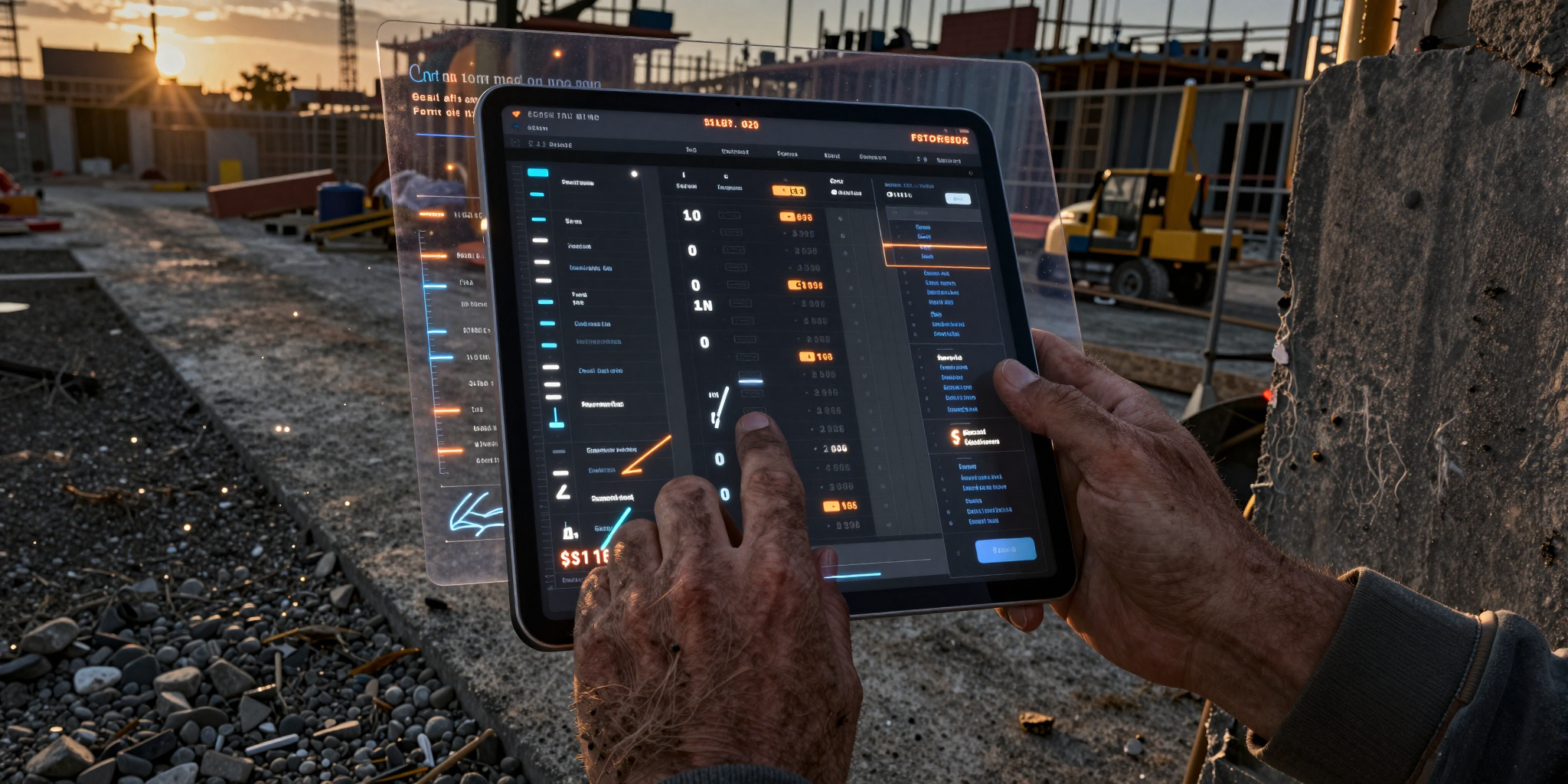

The single biggest leak in a contractor's sales funnel isn't the close rate. It's the delay between the site visit and the quote. Every hour between "looks good" and "here's the number" is an hour the homeowner is getting another estimate from someone else.
The iPad quote tool is the answer to that problem. Not an app from the app store. A custom, web-based estimating tool that lives on a bookmarked URL, runs in Safari on an iPad, and knows the business's pricing rules, material costs, labor rates, and margin targets — so the contractor can walk a job, input the measurements, and hand the client a real number before leaving the driveway.
"The contractor who hands you a quote in the driveway wins more often than the one who emails it Monday. Speed is a competitive advantage most contractors don't use."
How It Works
The tool is a form — but a smart one. The contractor walks the job and inputs real measurements: square footage, linear feet of edge, number of steps, surface type, existing condition (crack repair needed, demo required, etc.). Those inputs run through a calculation engine that knows the business's actual costs.
Material cost per square foot for brushed concrete is different from stamped. Labor rates change for second-story deck work. Mobilization has a floor. The rules engine holds all of that, so the field estimate is built on the same math the office would use — not a rough guess that gets revised later.
Output is a quote card: scope summary, line items if the contractor wants them, total price, and an optional deposit line. On an iPad, the client can sign right there with their finger. The signed quote gets emailed to both parties automatically.
Where AI Actually Fits
The calculator is rules-based — deterministic math the business controls. AI enters in two places.
First, scope description. The contractor selects job type and inputs measurements. The AI drafts the scope-of-work paragraph from those inputs: "Install approximately 480 square feet of brushed exposed aggregate concrete driveway with 6-inch integral color border, including demo of existing asphalt surface." Clean, professional language that didn't require typing.
Second, follow-up. If the client doesn't sign on-site, the tool queues a follow-up sequence — a text the next morning, an email two days later with the quote attached, a final check-in at the end of the week. The AI writes the messages; the system sends them. The contractor doesn't have to remember to follow up.
Why iPad Specifically
Phone screens are too small for a quoting tool. Laptop is a power move that reads as formal in the wrong way. An iPad is the right size, the right casualness, and clients are comfortable touching the screen. The tablet form factor says "professional but approachable" — which is exactly the register a contractor wants when asking someone to spend $15,000 on their driveway.
The tool is a web app, not a native app. That means no app store submission, no update approvals, and it works on any iPad with a browser. Update the pricing rules on the server; every device in the field picks up the change immediately.
Encoding Business Knowledge
The most valuable thing in the quoting tool isn't the UI. It's the business rules. What does a 1,200 square foot stamped concrete patio actually cost this business to deliver, with their specific crew, their specific supplier relationships, their specific market? That number is hard-won knowledge that lives in the owner's head and nowhere else.
The quoting tool is the extraction mechanism. Building it forces the conversation: what are your material costs? What's your labor rate on this job type? What's the minimum job size that makes sense for you? What margin do you need to cover overhead? The tool encodes the answers — and then enforces them on every field estimate, so a salesperson or a new hire can generate a quote that's consistent with what the owner would actually bid.
What This Unlocks
The obvious win is speed. Quotes in the field close faster than quotes by email. But there's a second win: consistency. When every estimate uses the same math, margin doesn't erode because someone guessed low. Scope creep becomes visible before the job starts, not after.
And there's a third win that takes longer to see: data. Every quote is logged. Over time, you can see which job types have the highest close rate, which zip codes convert best, what the average time-to-close is by project size. The quoting tool isn't just a calculator. It's the beginning of a business intelligence layer.